
Editor’s note: This is an independently researched food and travel guide. Pixel Passports has not claimed a personal visit, tasting, or interview. Menus, prices, hours, and accessibility can change, so confirm details directly before making a special trip.
Session Road is Baguio’s commercial spine, a sloping stretch where office workers, students, shoppers, journalists, and visitors have crossed paths for generations. Among newer cafés and familiar chains, Luisa’s Cafe offers a different kind of invitation: a family restaurant whose bowls of mami, steamed siopao, old booths, and upstairs tables hold pieces of the city’s everyday history.
A long-running restaurant can reveal more than a list of dishes. Luisa’s tells a story about Chinese-Filipino food in the Cordillera, the informal networks of local journalism, and the value of places where people return not for novelty, but for continuity. That is what makes Luisa’s Cafe Baguio worth understanding before ordering.
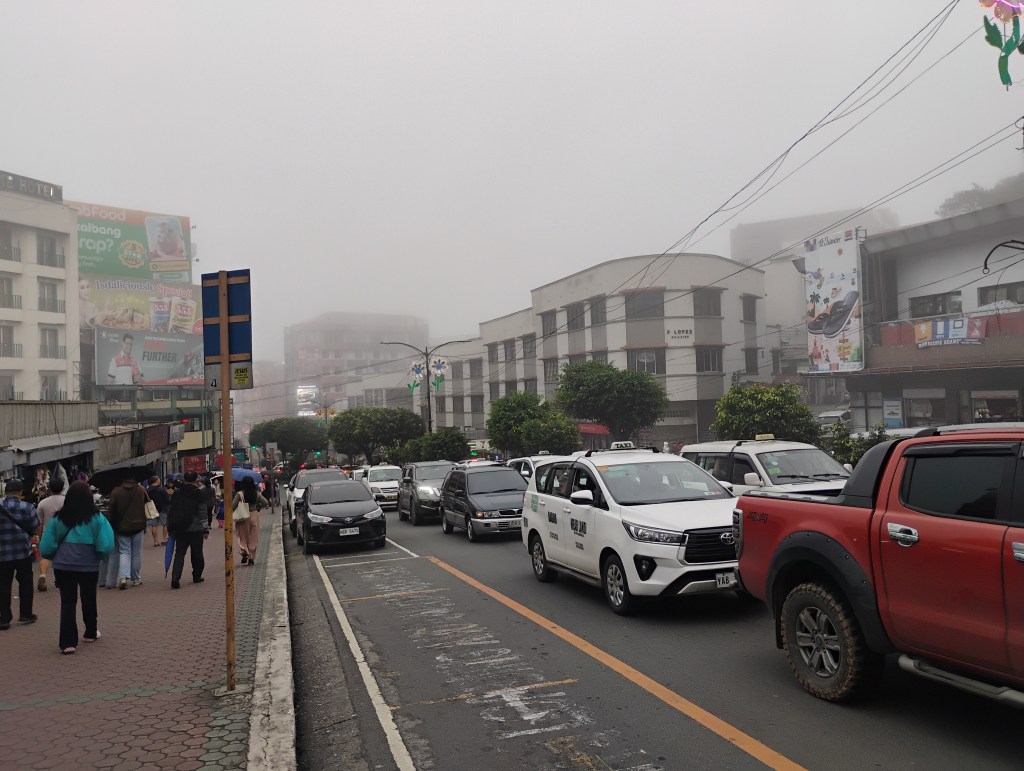
Featured photo: Foggy Session Road by Ralff Nestor Nacor, via Wikimedia Commons, used under CC BY-SA 4.0. Displayed at reduced size; no material edits.
A family restaurant with decades of history
The restaurant is associated with family matriarch Luisa She Wong and later operator Roland Wong. The broad outline is consistent: the business began away from its present Session Road address, operated on Carantes Street, and then moved to the city’s best-known commercial street. The exact founding year is less settled.
A 2024 food feature gives 1957 as the starting year, while a recent BusinessMirror account places the cafe’s roots in the late 1950s. SunStar Baguio, however, reports that the family set up on Carantes Street in the early 1960s before transferring to Session Road. Other older reports date its Session Road presence to the 1970s. Without a dated business record or family archive to settle the question, the responsible conclusion is that Luisa’s emerged around the late 1950s or early 1960s, with its better-known Session Road chapter developing later.
That uncertainty does not weaken its place in Baguio food culture. It shows how neighborhood institutions often survive first in memory, then in news features, and only imperfectly in formal timelines. The Wong family kept a straightforward Chinese-Filipino menu and a dining room that longtime customers recognized across changing decades.
The cafe where journalists gathered
Luisa’s became particularly important to Baguio’s press. SunStar described its second floor as a “second office” for local news workers, with a round table where reporters gathered over coffee and laptops. Beside the staircase, a vertical pigeonhole held envelopes, invitations, press releases, and messages for radio, television, and print journalists.
The system belonged to an era when a physical message box could connect a city’s officials, sources, and reporters. A 2014 media history explains that Baguio’s earlier press pigeonhole had been at Session Café. After that landmark disappeared, a smaller version continued at Roland Wong’s Luisa’s Cafe.
The upstairs room also welcomed artists, photographers, and community gatherings. In late 2025, its walls hosted work responding to the concerns of Baguio’s creative community, according to The Archipelago Press. Luisa’s therefore matters not only as a restaurant, but as a civic room where stories, pictures, arguments, and friendships have circulated.
The food that keeps people returning
The restaurant’s best-documented specialties are mami and siopao, two Chinese-Filipino standards that became deeply familiar across the Philippines. Mami is a hot noodle soup, commonly served with beef, chicken, wontons, vegetables, or combinations of meat. Siopao is a soft steamed bun filled with savory meat. Asado usually means a sweet-savory pork filling, while bola-bola uses a seasoned meatball-style filling.
SunStar reported in 2018 that Luisa’s noodles were handmade fresh each day and supplied to other restaurants. A visitor account from April 2024 also described handmade noodles in the special mami. That supports the cafe’s noodle-making reputation through 2024, but it does not prove that every noodle is still handmade today. Ask the restaurant if that detail matters to your visit.

Other dishes repeatedly associated with Luisa’s include beef mami, chicken mami, special mami, pancit canton, congee, and rice plates. Pancit canton is a stir-fried egg-noodle dish. Congee is a soft rice porridge that may be served with meat and savory toppings. Barako coffee, a strong Philippine coffee traditionally associated with Batangas and Cavite, also appears in visitor reports. Availability can change, so these are documented favorites, not a guarantee of the current menu.
What to order at Luisa’s Cafe
- Special or beef mami: The clearest starting point for understanding the cafe’s noodle tradition. Ask which mami variations are available and whether the noodles were made in-house that day.
- Asado or bola-bola siopao: A practical snack or partner for soup. Confirm the filling before ordering, especially if you avoid pork or have food allergies.
- Pancit canton: A useful choice for diners who prefer stir-fried noodles to soup.
- Congee: A gentle rice-porridge option, though the available meat and toppings should be checked at the restaurant.
- Luisa’s Rice: A documented combination plate with asado, fried chicken, mixed vegetables, and egg in a 2024 report. Confirm whether the same composition remains on the menu.
- Coffee: Ask what brew is being served rather than assuming barako is always available.

Historical price reference, not a current menu
An April 13, 2024 dining report listed Special Mami at ₱300 (about $4.70), bola-bola siopao at ₱75 (about $1.17), and Luisa’s Rice at ₱185 (about $2.90). These figures are historical and should not be treated as today’s prices.
Currency note: Dollar estimates use ₱63.852 per US$1, the latest available Bangko Sentral ng Pilipinas daily peso-per-dollar rate when checked on November 2, 2026. The quoted rate is dated October 30, 2026 because November 2 was a Philippine holiday. Actual card, bank, and cash exchange rates vary.
What visitors should know
- Address: 53 Session Road, Baguio City, Benguet, Philippines. Open a map search.
- Hours: Recent third-party listings and the 2024 dining report show daily hours of 7 a.m. to 10:30 p.m. No official live schedule was found, so call ahead at (074) 442-2412 before a time-sensitive visit.
- Getting there: Session Road is in central Baguio and is easy to combine with a downtown walk. Taxis and jeepneys serve the city center, but traffic and parking can be difficult during weekends, holidays, festivals, and the morning rush.
- Accessibility: Historical reporting describes a short staircase to the second-floor gathering area. A reliable current accessibility audit was not found. Contact the cafe about ground-floor seating, step-free entry, and restroom access before visiting.
- Payment: Current payment methods could not be independently verified. Bring Philippine pesos and confirm card or digital-wallet acceptance before ordering.
Why Luisa’s Cafe matters to Baguio
Luisa’s value is not based on a claim that every traveler will rank its food above every newer restaurant. Its importance comes from the relationship between family cooking and public life. The cafe carried Chinese-Filipino staples into Baguio’s daily rhythm, gave journalists a dependable meeting place, and made room for artists and photographers as the city changed around it.
Places like this make food heritage tangible. A noodle recipe, a steamed bun, a dumbwaiter, or a paper message box can hold the memory of work, migration, reporting, and friendship. Preserving that story does not require romanticizing every detail. It requires documenting what is known, acknowledging what is disputed, and supporting local institutions with respectful expectations.
Final thoughts
For travelers asking where to eat on Session Road, Luisa’s Cafe offers more than a quick answer. Order what is available, ask about the noodles, look closely at the old room, and remember that the tables upstairs once helped a city’s news travel from hand to hand. Whether you come for mami, siopao, or Baguio food heritage, the deeper reward is seeing how an ordinary cafe became part of the city’s shared memory.
Frequently asked questions
What is Luisa’s Cafe Baguio known for?
It is best known for Chinese-Filipino comfort food, especially mami and siopao, and for its long association with Baguio journalists, artists, photographers, and community gatherings.
When did Luisa’s Cafe open?
Sources disagree. Some give 1957 or the late 1950s, while SunStar places the Carantes Street beginning in the early 1960s and other reports associate the Session Road era with the 1970s. No primary record located for this article resolved the discrepancy.
Are Luisa’s Cafe noodles handmade?
Reporting from 2018 and a visitor account from 2024 described handmade noodles. Current daily production was not independently confirmed, so ask the restaurant when you order.
What should a first-time visitor order?
Mami paired with asado or bola-bola siopao is the most historically representative starting point. Availability and prices should be confirmed from the current menu.
Explore more Philippine food and heritage
Browse more stories in the Pixel Passports Food section. Continue the heritage theme with the guide to Vigan’s historic streets and Ilocano food, compare regional noodle and snack traditions in the Ilocos empanada food guide, or read why Pixel Passports follows local food spots across the Philippines.
Research and practical sources
- SunStar Baguio: “Luisa’s Cafe: Enduring the Times”, September 1, 2018
- SunStar: “Baguio Media Notes and Anecdotes”, March 21, 2014
- BusinessMirror: “Sunday, Baguio, Sunday”, November 1, 2026
- The Archipelago Press: “On the Walls of Luisa’s Cafe”, updated May 5, 2026
- Zoy to the World: Luisa’s Cafe dining report, April 13, 2024
- Bangko Sentral ng Pilipinas: Daily Philippine peso per US dollar rate, latest available October 30, 2026; checked November 2, 2026
- Restaurant Guru: current third-party listing, checked November 2, 2026. Used only for operational leads that require direct confirmation.


Leave a Reply